The Pleiades (M45)
"It was always driven by the visuals and trying to understand how they came to be. My favorite sky object is Pleiades, the seven sisters."
The vault is mostly career archaeology. This entry is not. It is here because the Pleiades is the one object in the sky Richard names when asked — his favorite since childhood, and still — and because the reason he names it turns out to be the same reason he has spent forty years on interfaces.
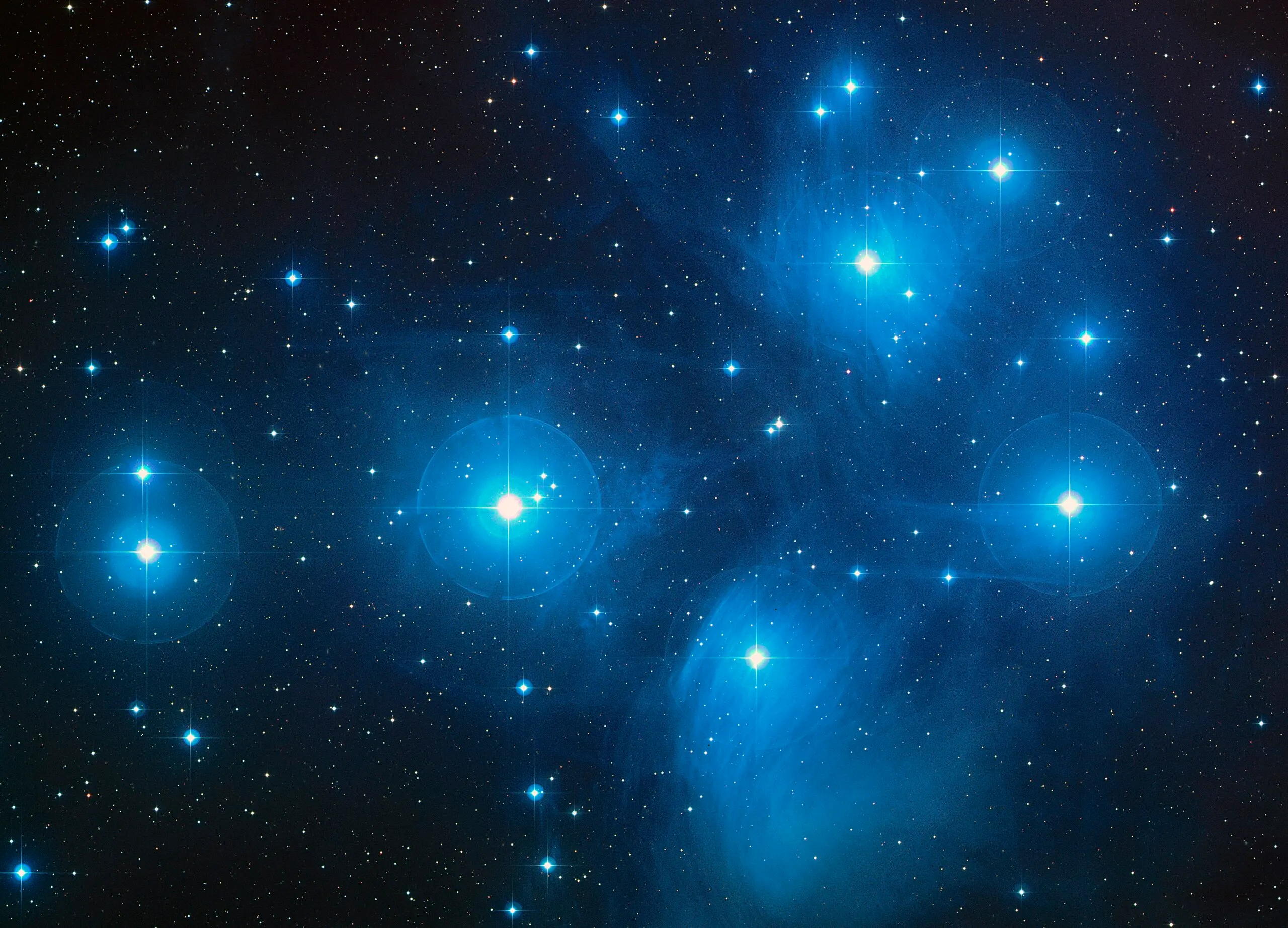
NASA, ESA, AURA/Caltech, Palomar Observatory — STScI-2004-20. Public domain.
The Object
M45, in Taurus. Naked eye it is a tight knot of stars, soft and slightly hazy — the number you can resolve has served as a traditional test of visual acuity in cultures across the world. Binoculars open it into hot blue-white stars embedded in wispy nebulosity.
Two facts about it matter more than the rest:
It is young. Roughly 100 million years — an infant by stellar standards. The stars are still tangled in the remnants of the molecular cloud they condensed out of. The nebulosity is a reflection nebula: it catches starlight rather than emitting its own.
It is temporary. The cluster is gravitationally bound but slowly unbinding. In a few hundred million years it will have dispersed into the general stellar population of the galaxy, unrecognizable as the thing that nearly every culture that ever looked up independently named and told stories about.
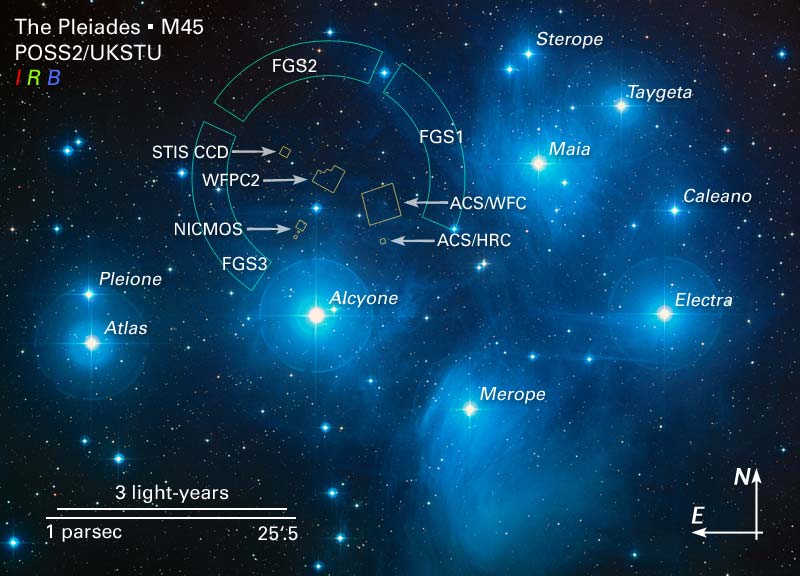
NASA, ESA and AURA/Caltech — STScI-2004-20. Public domain.
The Seven Sisters proper are Alcyone, Maia, Electra, Merope, Taygeta, Celaeno, and Sterope — with Atlas and Pleione, the parents, off to one side. The scale bar is worth pausing on: the whole naked-eye impression spans about three light-years.
The overlaid boxes are not decoration. Those three arcs marked FGS1, FGS2, and FGS3 are Hubble's Fine Guidance Sensors, and this diagram is the pointing plan for the observation that settled how far away the cluster actually is. ESA's Hipparcos satellite had put the Pleiades about 10 percent closer than the traditional estimate. Hubble measured the parallax of three cluster stars from opposite sides of Earth's orbit and got about 440 light-years — more than 40 light-years further out than Hipparcos, vindicating the older figure and, with it, the standard model of how stars of that age should look.
So the image is at once the aesthetic object and the engineering diagram of how it was measured. That is precisely the two-part answer Richard gave when asked what drew him to astronomy: the visuals, and how they came to be.
Why This One
The answer he gave was about visuals and about how they came to be — both halves, in that order. That is a specific taste, and the Pleiades is a specific object for satisfying it.
It works at three scales at once. There is the naked-eye impression. There is the binocular view, where the nebulosity resolves. And there is the astrophysics underneath, which is the part that explains the other two: simple rules — stellar formation, gravitational dynamics, stellar evolution — running forward over geological time.
Which makes the Pleiades not a static object but a moment in a process. That is the same shape as the rest of the intellectual thread: fractals, cellular automata, subdivision surfaces, PostScript stacks, Interlisp-D. Emergent complexity from simple recursive rules, observed at whatever scale happens to be available. The cluster is that fascination rendered at 440 light-years and made beautiful.
The line from here to the declarative lineage is not decorative. A declarative spec and a reactive runtime is the same bet: describe the rules, let the complexity emerge, don't hand-place the result.
The Telescope That Was Never Bought
There are star chart and telescope control apps on the iPhone. There is no telescope.
"I have at least a handful of star chart and telescope control apps on my iPhone, someday…."
This is the recurring pattern, and it is not a failure. Modo and Lightwave licenses bought years ago and never used, for Landmate models never built. Japanese dictionaries for Shirow footnotes not yet readable. Star Citizen ships bought "ages ago" for a game he was never much interested in playing — the draw was the design universe, not the gameplay.
The apparatus of intention gets acquired first. Whether the expedition departs is a separate question, and a less interesting one than it looks: the someday list is the external evidence of an interior world still running at capacity. Every item crossed off reveals three more worth adding.
First Destination
He played Elite Dangerous — one of the more astronomically faithful simulations ever built, using real catalog data and genuine stellar distances. One of his very first destinations in the game was the Pleiades.
"I went on to play Elite Dangerous and believe it or not one of my very first destinations in that game was Pleiades..."
The game also happens to center its Thargoid alien presence on that same region — the Unknown Artifacts, the community-wide mystery, the closest thing Elite Dangerous has to a first-contact narrative. For someone whose reading DNA starts with VOR and alien-as-scientific-puzzle, the overlap is almost too neat.
It is also a coincidence, and he was clear about that:
"actually, i don't think i knew about it at the time. I just wanted to visit it because it was 'there' and accessable..."
That is the more interesting version. He did not follow the lore. He went because the object was there and the game had, for the first time, made it reachable — not a view through glass but a place you can drop out of hyperspace into. Star chart apps can show you where it is. A telescope would show you what it looks like. Elite Dangerous was the first thing that offered to put him inside it.
The alien mystery was already waiting when he arrived. Nobody planned that.
Both images come from the same Hubble release — STScI-2004-20, "Hubble Refines Distance to Pleiades Star Cluster," June 1, 2004 — and are in the public domain, having been created by NASA. Credited above as their Wikimedia Commons records specify: the wide field to NASA, ESA, AURA/Caltech and Palomar Observatory; the annotated plate to NASA, ESA and AURA/Caltech.