VOR — James Blish (1958)
"The strange being—soon to be known to all mankind as VOR—emerged..." — back cover, Avon Original S313
The book that started everything. The first sentence of the biography puts it plainly: a dog-eared paperback read as a teenager in the Midwest. Not Clarke, not Asimov, not Heinlein — Blish. A 60¢ Avon paperback with a glowing ovoid on the cover and red eyes in the dark.
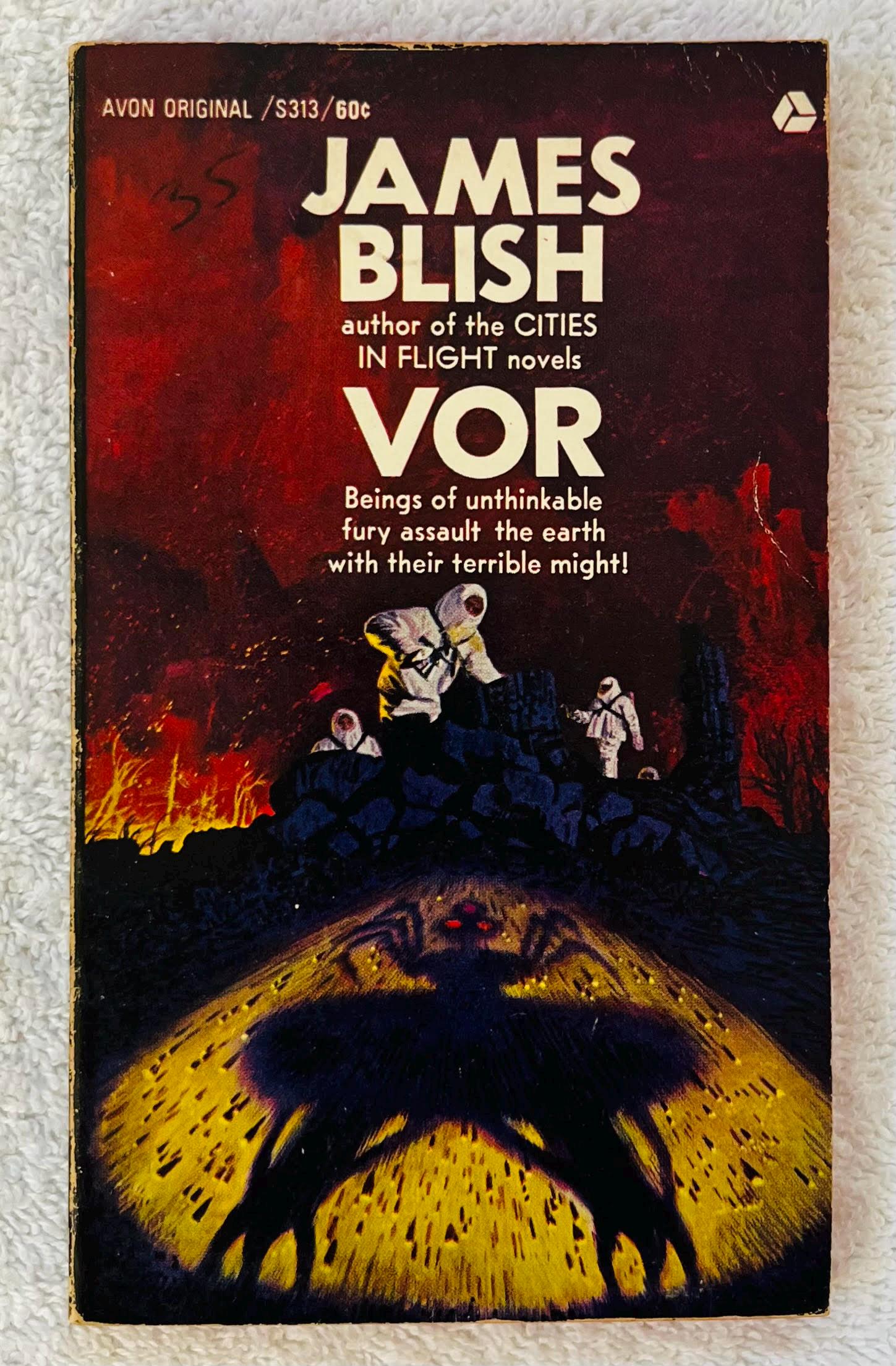
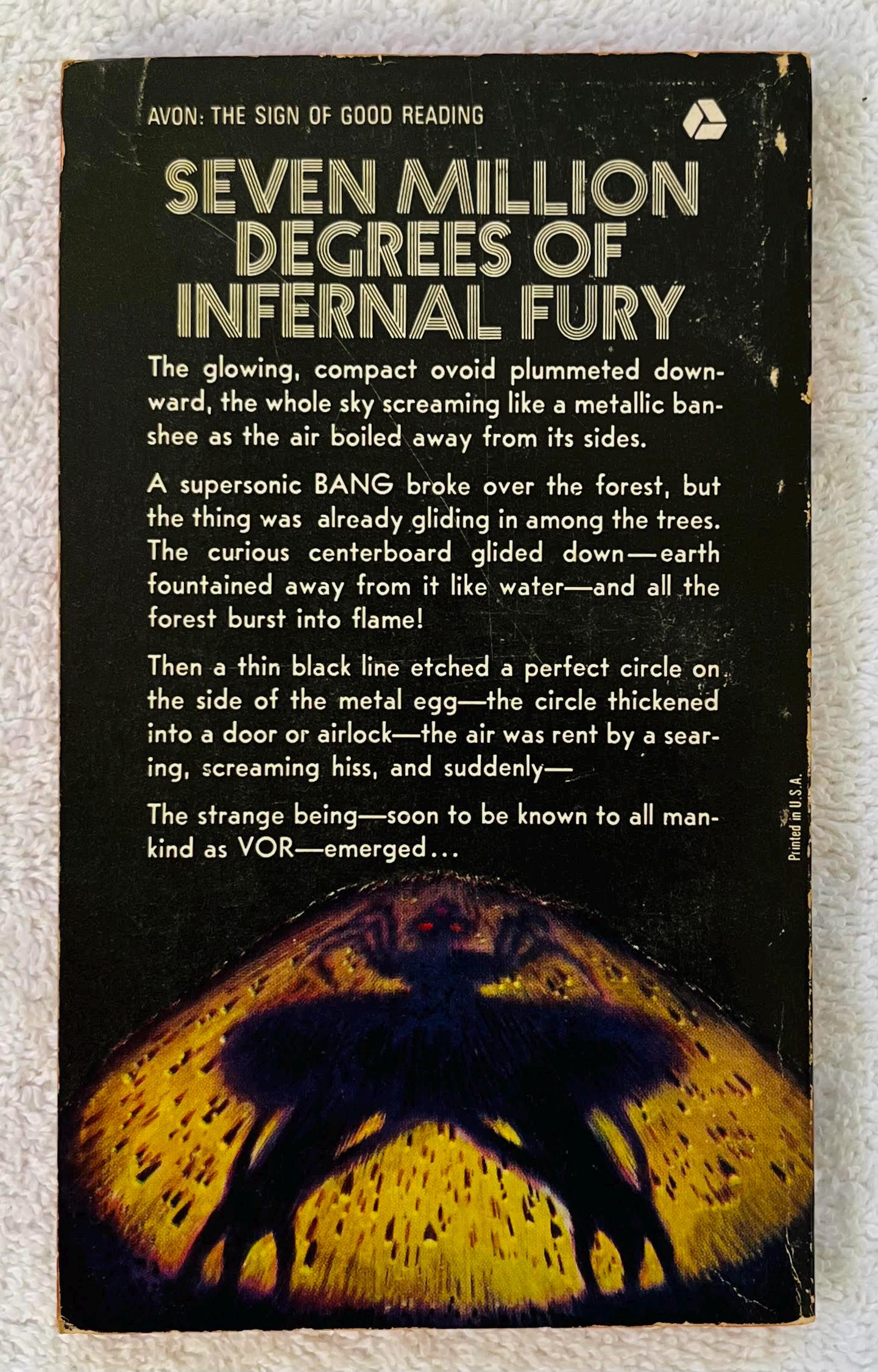
The physical copy: Avon Original S313, priced at 60¢. Cover art shows hazmat-suited figures standing on rubble above VOR, wreathed in orange fire, the creature's dome filling the lower half of the frame — two red eyes, bioluminescent yellow-gold hide, something that reads simultaneously as egg, machine, and face. The back cover leads with "SEVEN MILLION DEGREES OF INFERNAL FURY" in hollow block type, then a passage describing the crash: the ovoid plummeting, air boiling away from its sides, a centerboard drilling into the earth, forest igniting. Then the airlock circle etching itself into the metal skin.
The Premise
VOR is not an invasion novel. The military posture of the cover — the hazmat suits, the title tagline ("Beings of unthinkable fury assault the earth with their terrible might!") — is Avon's marketing, not Blish's intent.
VOR is an alien that operates as a living nuclear reactor. Its biology runs on fission. It radiates. It burns everything it touches not from aggression but from physics. It landed in a forest and the forest caught fire because that's what happens when something running at seven million degrees touches dry wood. The creature is not hostile in any meaningful sense — it is simply operating according to its nature in an environment that is catastrophically incompatible with it.
That's the actual horror, and the actual interest. Not a monster. Not an invader. Something genuinely, constitutively alien — an intelligence whose substrate is nuclear energy, whose needs are expressed in radiation, whose presence is lethal to the organisms around it not as a weapon but as a side effect of existing.
Blish was interested in the question that serious SF keeps returning to: what does first contact actually look like when the other party is not a humanoid with different skin or politics but something that doesn't share your chemistry, your sensory range, or your frame for what "communication" even means?
1958 Context
The date matters. VOR was published the same year Sputnik circled Earth and the US was deep into atmospheric nuclear testing. The Avon S313 paperback was sold at drugstore racks during a period when "nuclear" was the ambient background radiation of public anxiety — fallout shelters, duck-and-cover drills, the Castle Bravo test still four years in the rearview.
An alien that is a nuclear reaction is a 1958 idea in a way it couldn't be in any other decade. It uses the era's central fear as raw material and turns it sideways — the terrifying thing is not the bomb but the being that lives inside the reaction, that requires the temperatures we've been building weapons to produce.
Blish was not writing allegory in any clumsy sense. But context saturates a premise.
Blish's Place
James Blish is credited on the Avon cover as "author of the CITIES IN FLIGHT novels" — the Okie cycle, four books about cities that rip themselves off the Earth using antigravity drives and become itinerant labor in a galaxy-spanning economy. Blish applied Oswald Spengler's theory of civilization cycles — rise, decay, inevitable fall — to galactic history. A Case of Conscience (1958, same year as VOR) won the Hugo and asked whether a world without original sin could exist within Catholic theology. He was not a writer who wrote small.
VOR is one of his shorter, pulpier works — but the seriousness is there. The alien is worked out. Its biology is considered. The military and scientific response is examined with the procedural rigor Blish brought to most things.
Why It Comes First
In the biography, VOR is the first book named. Not as a childhood favorite in a general sense — as the origin point. Before the career arc, before the platforms and the frameworks and the forty years of interface work, there is: a dog-eared 60¢ paperback, a teenager in the Midwest, and a glowing ovoid that crashed out of the sky and burned everything it touched.
The pattern that follows — the interest in systems that don't behave like you expect, in edges where different ontologies collide, in things that operate by their own internal logic regardless of what human observers want them to do — that pattern is in this book. The alien isn't malfunctioning. It isn't evil. It is exactly what it is. Everything else is the human problem.
That's the first lesson. It's still running.